

What is the blood-brain barrier?
Blood vessels carry blood from the heart to all the organs in the body and return the blood to the heart to complete the circuit. Blood vessels deliver oxygen and nutrients to the tissues, remove carbon dioxide and metabolic waste from them, transport hormones among numerous other functions. The vascular tree is comprised of the major arteries, the smaller and smaller branches and arterioles, which deliver blood to the tissues, the capillary bed, which is essential for exchange of gases and nutrients within tissues, and venules and veins, which drain blood from tissues and back to the heart.
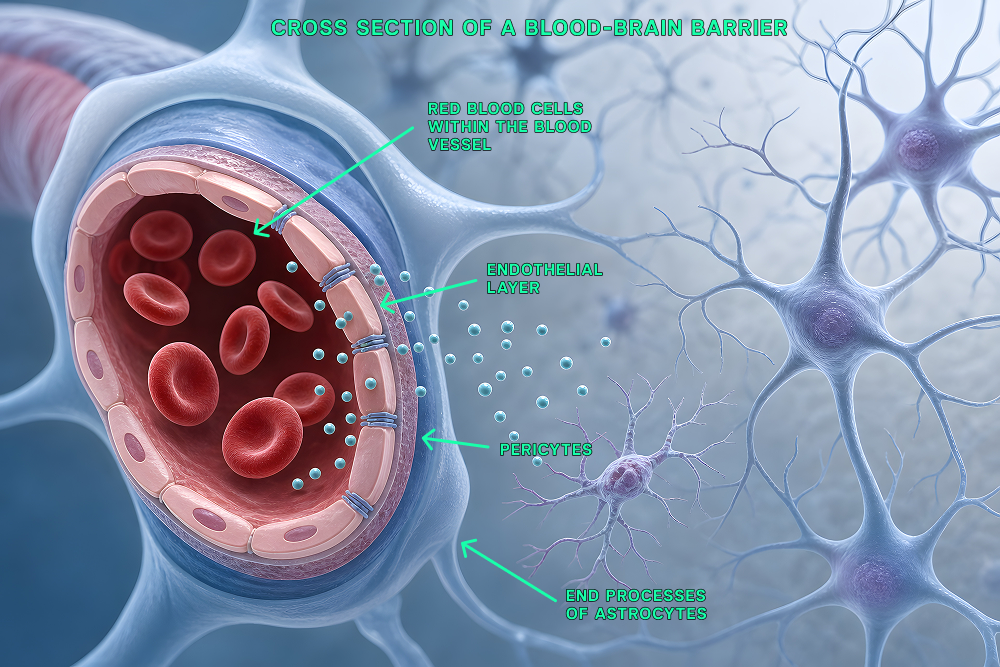
The wall of each blood vessel is specific to the function it serves. In particular, the microvasculature, which is made up of the capillaries and postcapillary venules, has highly specialized properties to meet the unique requirements of the tissue they vascularize. The blood-brain barrier is a semi-permeable wall of the microvasculature of the central nervous system. It is made up of a lining of cells endothelial cells, pericytes and foot processes of the astrocytes (cells that support and help neurons) that seem to embrace it. Together this arrangement helps to regulate the molecules and cells that enter and exit the brain tissue making it a highly regulated and controlled environment.
How is it relevant for multiple sclerosis?
In multiple sclerosis, the blood-brain barrier gets disrupted which allows activated immune cells (T cells and B cells) to infiltrate the central nervous system from the blood and once inside these cells cause inflammatory injury destroying myelin and killing neurons. This invasion of immune cells from the periphery into the brain can cause new lesions which lead to relapses. We can see evidence of blood-brain barrier breach on an MRI when we see a contrast enhancing lesion. Normally contrast molecules cannot enter the brain tissue, but when there is a breach in the barrier, the way injurious immune cells entered, contrast molecules can also enter the tissue and this is what makes a lesion enhance. After this happens the blood-brain barrier is usually repaired and that is why if one repeats an MRI in about a month the lesion will not contrast enhance anymore.
The blood-brain barriers is also relevant to the treatment of multiple sclerosis. Especially in progressive forms of MS, significant injury is caused by resident immune cells within the brain tissue, unlike in relapses where immune cells enter from outside. In order for a treatment to be effective it needs to cross the blood-brain and get to the target cells causing disease progression. Many of the medications are not able to cross the blood -brain in concentration that will make them work, this is an impediment to their efficacy. With advancements in medicine, one of the avenues that is being explored is making small drug molecules that can cross the blood-brain barrier or creating a drug delivery system that can get the medication across the blood -brain barrier.